Does a Small Business in PEI Still Need a Website in 2026?
Solve Trend7 min read
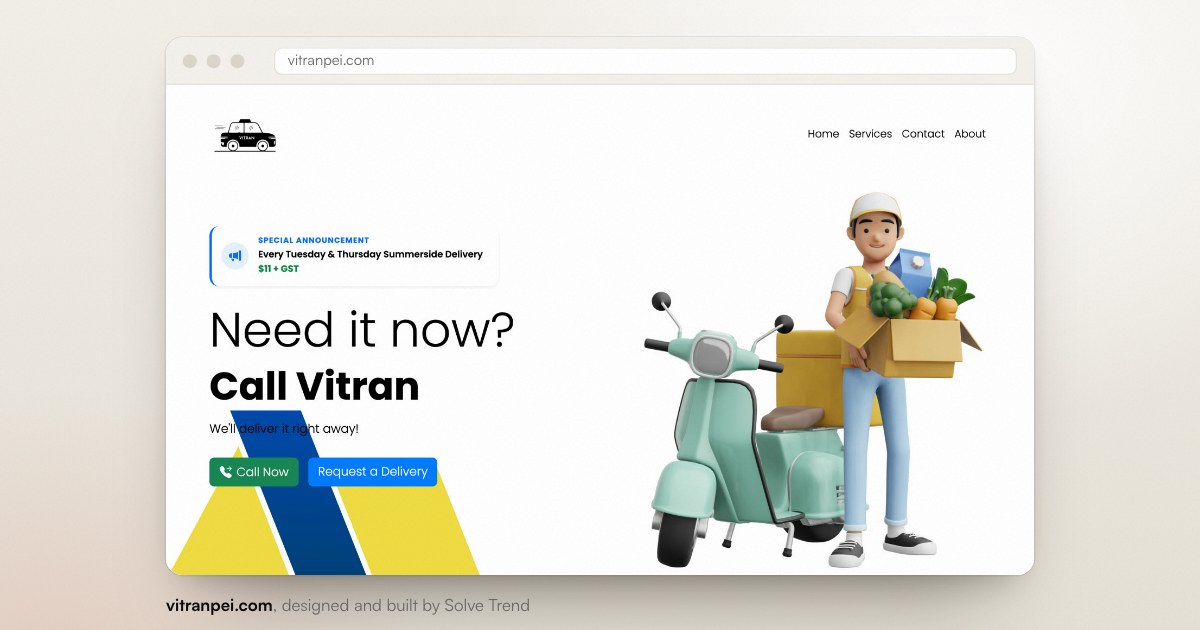
Not every PEI business needs a website on day one. If you're a one-person operation that gets nearly all its work by word of mouth, a well-kept Google Business Profile can carry you for a while. Once you sell to tourists, take bookings, quote jobs, hire, or want to show up for searches beyond your own name, a simple website pays for itself, and the platforms you'd rely on instead don't belong to you.
Here's how to tell which side you're on, what Canadian small businesses actually do, and what the smallest useful website contains.
What do Canadian small businesses actually use?
The best recent numbers come from the Canadian Federation of Independent Business. Its September 2025 survey of 2,478 business owners found (CFIB):
- 78% of small firms have a company website. For micro firms with 0 to 4 employees it's 70%; for firms with 50 or more, 91%.
- 59% use Facebook, 52% use Google Business Profile or Maps, and 41% use Instagram.
- Nearly half name their website as their most useful channel, ahead of Facebook and then Google Maps.
- Among firms in business 11 years or more, over half say the website is most useful. Among firms in business 2 to 4 years, about a third do. Younger firms lean harder on Facebook (72%) and Google Business Profile (66%).
- About 1 in 10 businesses use no digital channel at all. The top reasons: the tools aren't relevant to their customers (55%) or there's no real need (38%).
CFIB doesn't break those results out for PEI, and we couldn't find Island-only data. But the pattern is useful: newer businesses start on social and Google, and the ones that last tend to end up relying on their own site.
When is a Google Business Profile and Facebook page enough?
A Google Business Profile is free. Google says so on its own page, and it lets you show hours and contact details, add photos, post offers and updates, respond to reviews, and in some cases take bookings. For a lot of local searches, that's what people see first.
Google plus Facebook can be enough when all of these are true:
- You serve a small area, and most customers already know your name or were referred.
- You don't take bookings, sell online or send quotes.
- Your offer is easy to explain in a few lines and a few photos.
- You're not hiring, applying for funding, or pitching to bigger clients who'll want to look you up.
- You keep the profile current: hours, holiday closures, photos, and replies to reviews.
If that's you, put your effort into the profile and reviews first. Our guide to getting more Google reviews without gating covers the asking part.
When do you need a website?
The case for a site gets strong fast once any of these apply:
- People check you before they contact you. BrightLocal's 2026 survey of 1,002 US adults found 54% visit a business's website after reading positive reviews, up from 32% when the question was last asked in 2019 (BrightLocal). That's US data, but the habit isn't hard to recognise here: reviews get the shortlist, the website gets the call.
- You want to be found for what you do, not just who you are. A profile helps with "near me" searches. A site with a page per service gives search engines something to rank for "heat pump install Summerside" or "cottage rental North Rustico". More on that in our PEI local SEO guide.
- AI assistants are recommending businesses. BrightLocal found 45% of consumers used ChatGPT or other AI tools for local recommendations, up from 6% a year earlier. Those tools need clear, public, readable information about you. A Facebook page often asks visitors who aren't signed in to log in first. Your own site doesn't.
- You take bookings, sell, or quote. A form that collects the details you need saves a round of phone tag on every enquiry.
- You're hiring or applying for funding. Applicants, lenders and grant officers look you up too.
- You don't control the platform. Facebook can change what followers see, and a page can be locked or hacked. Your domain and your site are the one place online you own outright.
What about seasonal and tourism businesses?
Tourism operators on the Island have the strongest case of anyone. Visitors plan from away, often months ahead, on phones, comparing several places. They want rates, dates, photos, directions, cancellation terms and a way to book or ask without waiting for a callback. They also can't drop in to ask.
Seasonal businesses also face an off-season problem: a Facebook page that goes quiet from October to May looks closed. A website with clear season dates and an "opening June 2027" line answers the question for you. If you run a cottage, a tour, a restaurant or an attraction, see our page on websites for tourism operators and public bodies.
What about trades and contractors?
Trades are the closest call. Plenty of good Island contractors are booked solid through referrals and never need a site. But referrals still check you out, and a homeowner choosing between two names will often pick the one with photos of finished work, a clear list of services and areas, and an easy way to send details. A simple site also lets you set expectations: what you do and don't take on, minimum job sizes, and lead times. That filters the calls you'd turn down anyway.
What about restaurants and cafés?
For restaurants, the menu is the website. People want the current menu, hours, location, and how to order or reserve. Posting the menu as a photo on Facebook works poorly: it's hard to read on a phone, impossible to search, and goes out of date. A one-page site with a real text menu, hours that match your Google profile, and links to ordering or reservations covers most of what diners look for. CFIB found 49% of hospitality businesses with a website use it to sell directly (CFIB).
What does a minimum useful website contain?
Not much. A small site that answers the obvious questions beats a big one that doesn't. The minimum:
| Element | Why it matters | Common mistake |
|---|---|---|
| What you do, where, and for whom, in the first screen | Visitors decide in seconds whether they're in the right place | A slogan instead of a plain description |
| Phone number and a short contact or booking form | Most visits on a phone end in a tap to call or a form | A number that isn't tappable, or a form that emails nobody |
| Hours, season dates and service area | Saves the calls that ask only this | Hours that don't match your Google Business Profile |
| Real photos of your work, place or product | Trust, and something for Google and AI tools to show | Stock photos that could be anywhere |
| A page per main service or offer | Gives you a chance to rank for each one | Everything crammed into one paragraph |
| Your own domain and a professional email | You own it, and it looks established | The domain registered in a past web designer's name |
Build it to load fast on a phone and to meet basic accessibility standards. Our WCAG guide for PEI organisations has a 12-point checklist you can run yourself.
What will it cost?
A DIY builder costs a few hundred dollars a year plus your time. Hiring someone ranges from a few hundred dollars for a landing page to several thousand for a full small business site. Our full breakdown, with sources, is in how much a website costs in PEI. Our own prices: a one-page Landing Page is $890 and a Business Website of up to eight pages is $2,490, both fixed (pricing).
If you don't have a website yet, Innovation PEI's Small Business Assistance Program can cover 50% of eligible website creation costs, up to $2,500. You must apply before you commit to a vendor. Our website funding guide has the details.
Our honest take
If you're busy, booked out and every customer comes by referral, you don't need to rush. Keep your Google profile sharp and revisit this when that changes. If you're seasonal, you sell to visitors, you quote jobs, or you're trying to grow beyond the people who already know you, a small, fast, well-written site is one of the cheapest pieces of marketing you'll ever own. We build those from Stratford for businesses across the Island; see our web design and development service or our Charlottetown web design page, and if you want the marketing around it too, digital marketing in PEI.
Website FAQ for PEI businesses
Do I need a website if I have a Facebook page?
Not always. If you're small, local and referral-based, Facebook plus a Google Business Profile can be enough. Once you take bookings, sell to visitors, quote jobs or want to rank for your services, a website does things a Facebook page can't, and you own it.
How many small businesses in Canada have a website?
78% of small firms, according to CFIB's September 2025 survey of 2,478 owners. For micro firms with 0 to 4 employees, it's 70%.
Is a Google Business Profile free?
Yes. Google says creating a Business Profile and listing your business is free. It's worth setting up whether or not you have a website.
What's the smallest website worth having?
One page that says what you do, where and for whom, with a tappable phone number, a working form, hours or season dates, real photos and your own domain. Add a page per main service when you want to rank for those services.
Is there funding for a first website in PEI?
Innovation PEI's Small Business Assistance Program covers 50% of eligible website creation costs up to $2,500 for businesses without a website. Apply before signing with a vendor.