5 Signs Your Business Has Outgrown Its Spreadsheets
Solve TrendJuly 5, 20264 min read
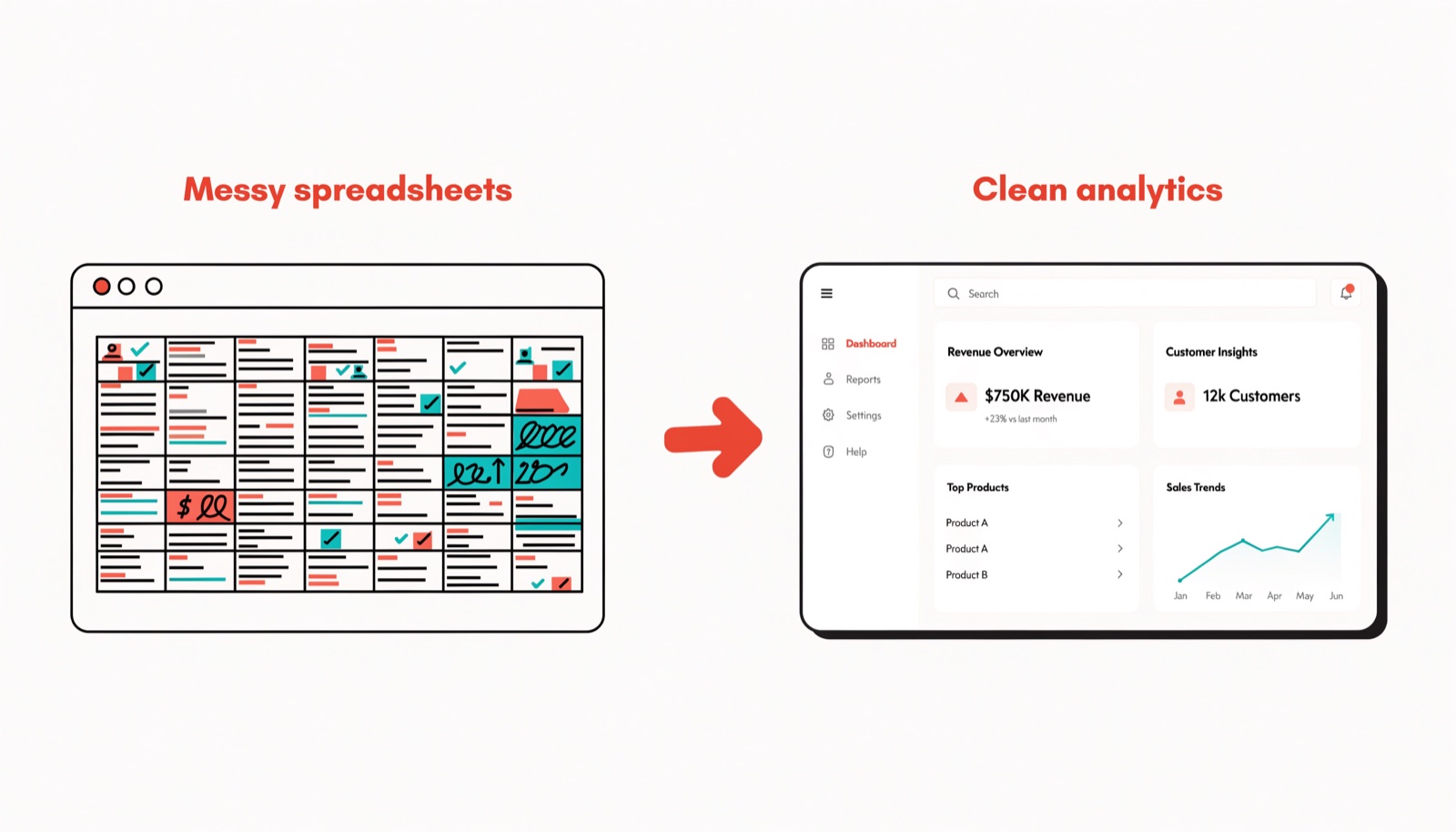
Spreadsheets are genuinely great: flexible, free, and instantly understood. Most businesses run on them far longer than they should, because the moment they stop being enough is easy to miss. Here's what that moment usually looks like.
1. Two people can't safely work at once
When "who has the file open?" is a real question, or someone's edits routinely overwrite someone else's, the spreadsheet has quietly become a bottleneck. Real systems handle concurrent users without anyone stepping on anyone.
2. The same data lives in three places
A contact in the sheet, in your inbox, and in your invoicing tool, kept in sync by hand. Every manual copy is a chance to be wrong, and the time spent reconciling adds up fast.
3. Reporting means an afternoon of copy-paste
If answering "how did we do last month?" requires stitching tabs together by hand, the data isn't structured for the questions you actually ask. A proper system answers those in a click.
4. Only one person understands "the sheet"
When your operation depends on one heroic spreadsheet only one person can maintain, that's not a tool. It's a single point of failure with formulas.
5. You can't automate on top of it
The moment you want reminders, approvals, scoring, or an AI layer on top of your data, a spreadsheet hits its ceiling. Those things want structure (defined objects, relationships, and rules), which is exactly what a custom tool or CRM gives you.
You don't replace spreadsheets because they're bad. You replace them when the workarounds cost more than the system would.
The good news: outgrowing spreadsheets doesn't mean a two-year software project. It usually means a focused first build (the core objects and the one workflow that hurts most) that you grow from there.
Working through this yourself?
If you’re weighing a custom build, a CRM, or an AI automation, we’re happy to talk it through: scope first, pitch later.