Missed-Call Text-Back Calculator for Trades (Formula Included)
Solve Trend5 min read
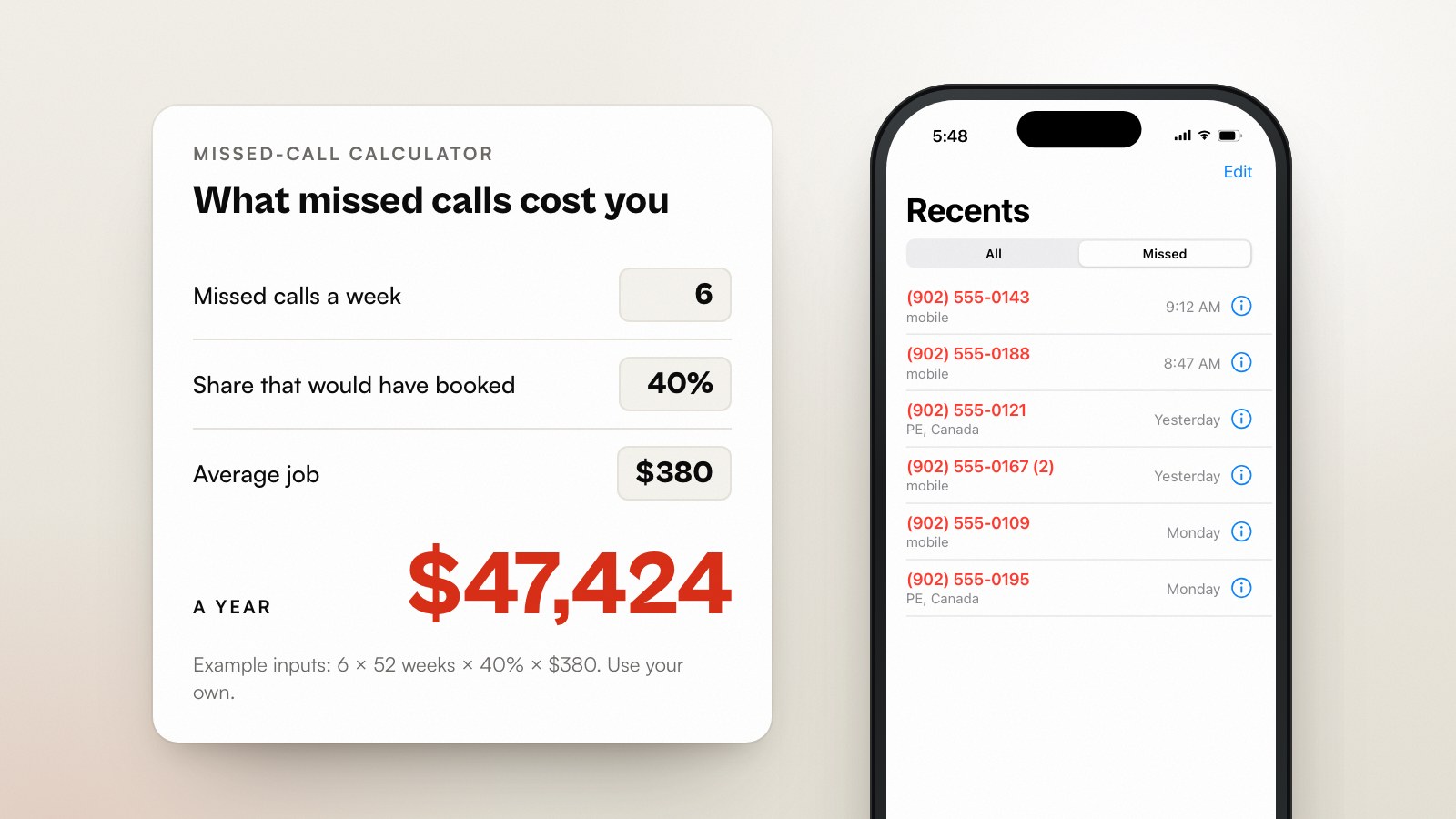
Missed calls cost a trades business roughly this: missed calls × the share that are new-job enquiries × the share you'd have booked × your average job value. The calculator below runs that sum with sourced defaults you can overwrite, then shows what a missed-call text-back could win back at three reply rates. No email, no sign-up, and the formula is printed under the result.
Most missed-call calculators online are built by companies selling the fix, and the maths shows it. We sell one too (here it is), so the defaults below are someone else's published numbers, and the reply rates are labelled as the guesses they are.
Calculator
What your missed calls are worth
Example value. Use your phone bill or call log.
Default 52%: Invoca's home-services average (range 32% to 74% by trade).
Default 38%: Invoca's share of answered calls that are leads. Excludes spam, suppliers and existing jobs.
Default 45%: Invoca's share of leads that convert on the call. Use your own close rate if you know it.
Example value. Use your average invoice for a first job, not your best job.
Missed calls a month
96
Of those, new-job enquiries
36.5
Revenue at stake a month
$5,746
$68,947 a year
If missed callers get a text back and some reply
| Reply rate (assumed) | Jobs won back a month | Revenue a month |
|---|---|---|
| Cautious10% reply | 1.6 | $575 |
| Middle20% reply | 3.3 | $1,149 |
| Hopeful30% reply | 4.9 | $1,724 |
The sum: 200 calls × 48% missed × 38% new enquiries × reply rate × 45% booked × $350 a job. Our Speed-to-Lead Setup is CA$1,490 one time, so at $350 a job it pays for itself after 5 recovered jobs.
The formula, step by step
Five numbers, multiplied in order. Each step removes calls that were never going to become paid work, which is the step most calculators skip.
- Missed calls = inbound calls × (1 − answer rate).
- Missed enquiries = missed calls × the share that are new-job enquiries. Spam, suppliers, existing customers and wrong numbers come out here.
- Revenue at stake = missed enquiries × your booking rate × average job value. This is what you'd earn if every one of those callers had reached you.
- Won back = missed enquiries × the share who reply to a text-back × booking rate × average job value.
- Break-even = the cost of the fix ÷ average job value, rounded up. That's how many recovered jobs it takes to pay for it.
Where the default numbers come from
Three defaults come from Invoca's July 2026 home-services benchmark, built from calls tracked on its platform (Invoca). They're averages across Invoca's customers, so treat them as a starting point, not your truth.
| Input | Default | Source and caveat |
|---|---|---|
| Answer rate | 52% | Invoca: 52% of calls answered by a person; 32% to 74% depending on the trade. |
| New-job enquiries | 38% | Invoca: 38% of answered calls are leads. Missed calls may skew differently, so check your own log. |
| Booking rate | 45% | Invoca: 45% of those leads convert on the call. A booked call isn't always a paid job; use your close rate if you track it. |
| Inbound calls | 200 a month | Example only. Replace with your number. |
| Average job value | 350 | Example only. Use the average first invoice, not your biggest job. |
| Text-back reply rate | 10% / 20% / 30% | Assumptions. We found no independent study of how many missed callers reply to a text-back. |
Why most missed-call calculators overstate the loss
They count every missed call as a lost job. One popular guide tells readers to count last week's missed calls and “multiply that number by your average ticket” (CHIIRP). That assumes every caller was a new customer who would have booked. Another counts “all missed calls, sent-to-voicemail calls, and calls where the client hung up” and multiplies by a conversion rate, with no step to remove spam or existing customers (Scheduling Kit).
- No enquiry filter. Robocalls, suppliers and “what time are you coming tomorrow?” calls aren't lost revenue.
- 100% booking. Even answered enquiries don't all book. Invoca's average is 45% on the call.
- No callbacks counted. Some missed callers ring back or leave a voicemail you return. That's why our numbers are “at stake”, not “lost”.
- Best-case job values. A calculator that uses your average ticket including the occasional full replacement inflates every line.
The honest number is smaller. It's also more useful, because it's one you can defend to a business partner, and it still tends to cover the cost of fixing the problem many times over.
A worked example
Take a plumbing business with 200 inbound calls a month, a 350-dollar average first job, and the Invoca defaults. It misses 96 calls. About 36 of those are new-job enquiries, and at a 45% booking rate that's roughly 16 jobs a month, or about 5,700 dollars of work at stake each month.
If a text-back gets a reply from one missed enquiry in five (the middle scenario), that's about 3 jobs won back, roughly 1,150 dollars a month. A CA$1,490 setup pays for itself after 5 recovered jobs at that job value, so in about two months on these assumptions. Change any input above and the sum updates.
What to do with your number
- Measure for two weeks. Pull your call log, count the misses, and tag each one: new enquiry, existing customer, spam. Replace the defaults with your numbers.
- Fix the cheap part first. If the result is more than a few hundred a month, a text-back is worth it. Here's how to build one with n8n and Twilio.
- Then follow up. Recovered enquiries turn into quotes, and quotes need a follow-up sequence.
- Re-run it in a month with your real reply rate. That's the number that tells you whether to go further, such as an AI receptionist for after-hours calls.
Context for the stakes: when Valve+Meter sent requests to 466 home-service companies, a company that hadn't replied within six hours had a 75% chance of never replying at all (Pro Remodeler). More numbers like that are in our speed-to-lead statistics roundup.
Missed-call calculator FAQ
How do I calculate the cost of missed calls?
Missed calls × share that are new-job enquiries × booking rate × average job value. Leave out the enquiry filter and you'll overstate it, sometimes by double or more.
What percentage of calls do home-service businesses miss?
Invoca's July 2026 benchmark found 52% of calls are answered by a person, so roughly half are missed, with answer rates from 32% to 74% depending on the trade.
How many missed callers reply to a text-back?
There's no independent benchmark we could find. Vendors report their own customers' results. Use 10% to 30% to plan, then measure your own after a month.
Is this calculator accurate for my business?
It's as accurate as the inputs. The defaults are industry averages. Replace them with your own call log and close rate and it becomes your number.
Do you store what I type?
No. The calculator runs in your browser. Nothing you enter is sent anywhere.
Sources
Working through this yourself?
If you’d rather not wire this up yourself,we’re happy to talk it through: scope first, pitch later.