Speed-to-Lead Statistics for Home Services (2026, Every Number Sourced)
Solve Trend5 min read
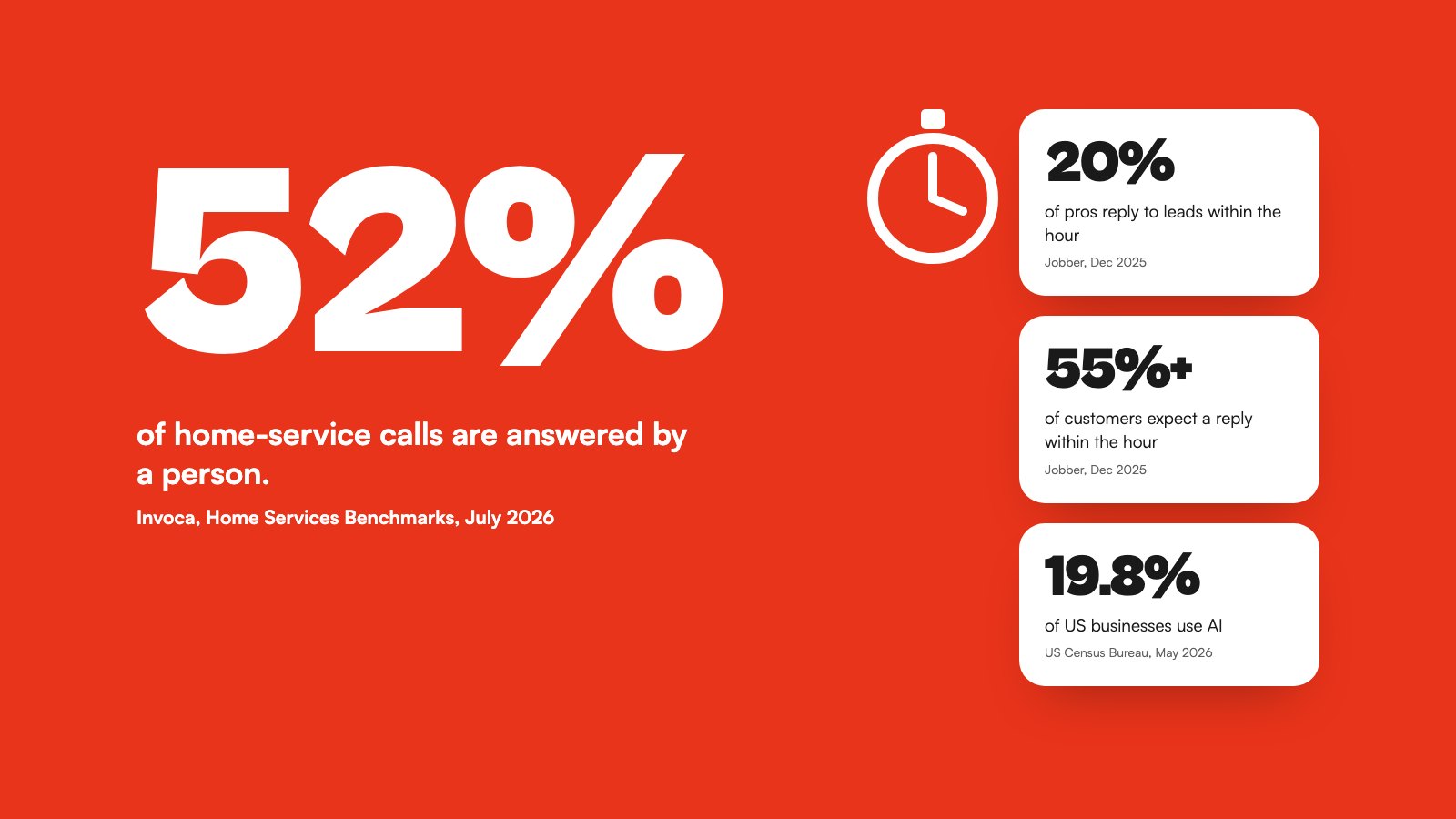
The short version: about half of home-service calls reach a person, most customers expect a reply within the hour, and most businesses don't reply that fast. Every figure below comes with who measured it, how many people or calls it covers, when, and a link. Where a popular statistic had no traceable source, we left it out and say so at the end.
Use these in a pitch deck, a budget meeting or an argument with your business partner. If you quote one, quote the source with it. A number without a sample size is a rumour.
What is speed to lead?
Speed to lead is the time between a customer reaching out (a call, a web form, a text) and your first real reply. It matters in home services because the customer is often contacting more than one business at once, so the first useful reply has the advantage. You improve it by answering more calls live, texting back the ones you miss within seconds, and replying to forms in minutes, not hours.
How many home-service calls get answered?
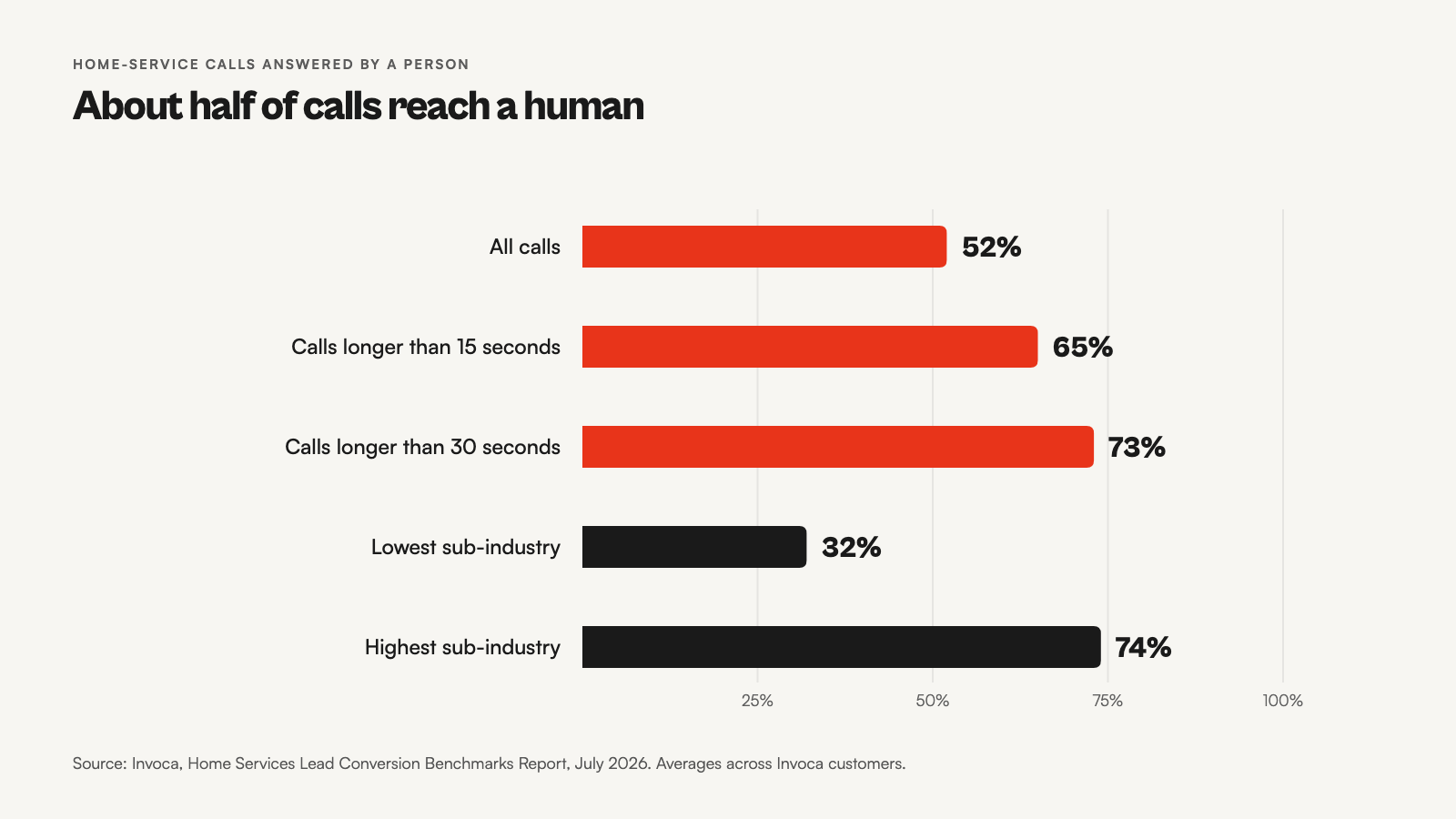
About half. Invoca's July 2026 benchmark, built from calls tracked on its own platform (averages across its customer base), found:
- 52% of calls are answered by a person.
- Calls longer than 15 seconds are answered 65% of the time, and calls over 30 seconds 73%. Short calls that hang up early drag the average down.
- Answer rates range from 32% to 74% across home-service sub-industries.
- 55% of home-service businesses don't ask leads to buy or book the job on the call.
Invoca also reports that 45% of leads on answered calls convert on the call (Invoca). Read that next to the 55% who never ask for the booking, and the cheapest growth lever in most trades businesses is a script, not an ad.
How fast do home-service businesses respond?
Slower than customers want. Jobber's December 2025 survey of 1,050 US home-service owners found 60% reply to leads the same day and 20% within the hour (Jobber). That's what owners report about themselves, so treat it as a best case.
A mystery-shopper test is harsher. In 2018 the marketing firm Valve+Meter put in service requests at 466 home-service companies. Only 60% had responded within five days. If a company hadn't responded in the first six hours, there was a 75% chance it never would (Pro Remodeler). The study is old, but it measured what companies did, not what they said, and nothing newer has replaced it.
What do customers expect?
A reply within the hour, and often right away. In the same Jobber survey, over 55% of customers expect a response within the hour and 28% expect an immediate reply. Put that next to the 20% of owners who reply within the hour and you have the gap that missed-call text-back and AI receptionists are built to close.
| What customers expect | What businesses do | Source |
|---|---|---|
| Over 55% expect a reply within the hour | 20% of pros reply within the hour | Jobber, Dec 2025 |
| 28% expect an immediate reply | 52% of calls are answered by a person | Jobber; Invoca, Jul 2026 |
| A follow-up on their request | 60% of companies responded within five days | Valve+Meter via Pro Remodeler, 2018 |
Quotes, pricing and win rates
Jobber's platform data shows top-performing businesses win over 60% of their quotes, a benchmark from its own customers' quotes rather than the survey. The same report found only 16% of pros offer tiered pricing such as good, better, best (Jobber). If you quote one price and wait, you're doing what most of your competitors do. Our estimate follow-up guide covers the alternative.
Reviews and trust
Speed gets you the call. Reviews decide whether people make it. BrightLocal's February 2026 survey of 1,002 US adults found (BrightLocal):
- 97% read reviews for local businesses.
- 68% will only use a business with four stars or more (55% in 2025), and 31% want 4.5 or more.
- 74% look for reviews written in the last three months.
- 47% won't use a business with fewer than 20 reviews.
- 89% expect owners to respond to reviews.
- 45% use ChatGPT or other AI tools for local recommendations, up from 6% the year before.
How many small businesses use AI?
Depends who you ask, and the gap is the story. National statistics agencies put AI use far lower than trade-software vendors do:
| Who measured | Population | AI use | When |
|---|---|---|---|
| US Census Bureau | All US businesses | 19.8%; under 20% for firms with 4 or fewer employees; 37% for 250+ | As of May 3, 2026 |
| Statistics Canada | All Canadian businesses | 12.2% used AI to produce goods or deliver services | Q2 2025 |
| Jobber | 1,050 US home-service owners | 52% use AI day to day; 54% of those for quoting | Dec 2025 |
| Housecall Pro | 248 US home-service pros | 48% actively use AI; 52% of users for customer communication and follow-up | May to June 2026 |
The Census Bureau also found AI use “didn't change significantly among firms with fewer than 20 employees” between December 2025 and May 2026. Statistics Canada reports that 9.6% of construction businesses plan to adopt AI software in the next 12 months. Read together: most small trades businesses haven't started, which means the ones that automate the basics now are competing against slow replies, not against robots.
Popular statistics we left out, and why
You'll see these everywhere. We didn't use them, because we couldn't trace them to a primary study that matches how they're quoted.
- “21 times more likely to qualify a lead if you respond within 5 minutes.” It traces to the Lead Response Management study by Dr. James Oldroyd with InsideSales.com, which used web-form leads from around 2007. It wasn't about phone calls or home services.
- “78% of customers buy from the first business to respond.” Usually credited to a lead-management vendor, with no published sample we could find.
- “85% of callers who reach voicemail never call back.” We found no primary source. Vendor pages cite each other in a circle.
- “391% more conversions when you respond within a minute.” Same problem: a vendor figure with no published method.
What to do with these numbers
Start by putting a number on it with the missed-call revenue calculator. Then three fixes cover most of the gap, and none of them needs a new hire. Text back every missed call within seconds (how to build it). Follow up every quote on a schedule (nine templates). Ask every finished customer for a review (the safe way). If you'd rather have all three running next month, that's what we build.
Speed-to-lead FAQ
What is speed to lead?
The time between a customer reaching out (a call, form or message) and your first real reply. In home services, the customer is usually contacting several businesses, so the first useful reply has the advantage.
What's a good lead response time for home services?
Under an hour, and seconds for an automated acknowledgement. Over 55% of customers in Jobber's survey expect a reply within the hour.
What percentage of calls do home-service businesses miss?
Invoca's July 2026 benchmark found 52% of calls are answered by a person, so roughly half aren't. It varies from 32% to 74% answered by sub-industry.
Is the “respond in 5 minutes” rule real?
The famous 21× figure comes from 2007-era web-form leads, not home-service calls. The direction holds up in newer data (Valve+Meter found replies after six hours often never came), but don't quote 21× as a home-services fact.
Sources
- Invoca, Home Services Lead Conversion Benchmarks Report, July 2026
- Pro Remodeler, Valve+Meter response-time study of 466 home-service companies, Dec 2018
- Jobber, Home Service Trends Report (1,050 US owners, Dec 2025)
- BrightLocal, Local Consumer Review Survey 2026 (1,002 US adults, Feb 2026)
- US Census Bureau, “Large Firms With at Least 20 Employees Biggest AI Users”, May 26, 2026
- Statistics Canada, AI use by businesses in Canada, Q2 2025 (June 16, 2025)
- Housecall Pro, The AI Advantage 2026 (248 US pros, May to June 2026)
Working through this yourself?
If you’d rather not wire this up yourself,we’re happy to talk it through: scope first, pitch later.