After-Hours Calls for Contractors: Five Ways to Handle Them (and When Each Fits)
Solve Trend6 min read
Pick the after-hours option by what a missed call costs you. If the caller has a flooded basement or no heat, you need a human or a tightly scripted emergency line. If the caller wants a quote for a deck, a fast text asking for the details is enough. Most trades need both: a short emergency path and an automatic reply for everything else.
This post is for plumbers, electricians, HVAC, roofers, landscapers and other home-service businesses where the phone rings at 7 pm and nobody answers. We don't quote statistics here. Call volumes and answer rates vary too much by trade and town, so we'd rather give you a way to work out your own numbers.
Why after-hours calls matter more than they look
People search and call when they're home: evenings, weekends, early mornings before a job. A homeowner with a problem rarely leaves one voicemail and waits. They try the next name in the list. The call you missed at 6:40 pm often goes to whoever picks up or replies first.
The cost isn't only the job you lose. It's also the review you never get, the repeat customer you never meet and the referral that goes elsewhere. That's why it's worth deciding on purpose how after-hours calls get handled, rather than leaving it to whether you happened to see your phone.
Option 1: Plain voicemail
It's free and it's what most small shops have. It works when your customers are patient and your work is scheduled well ahead, such as renovations and design-build projects. It fails for urgent work, because many people hang up without leaving a message, and the ones who do leave a message often don't leave a usable one.
If you stay with voicemail, improve the greeting. Say your business name, say when you'll call back (“by 9 am tomorrow”), give a text-friendly number and ask for name, address and what's wrong. A clear greeting gets better messages.
Option 2: A live answering service
A call centre answers in your business name, takes the details and sends them to you by text or email. It suits emergency trades where a person on the line matters. Check these before you sign up:
- Do they know your trade's words, or will they write down “furnace” as “fur nice”?
- Can they tell an emergency from a routine request using your own script?
- Is there a minimum monthly fee or per-minute pricing, and what counts as a minute?
- Can you listen back to recordings?
- Can they book into your calendar, or do they only pass on a message?
Services differ a lot in quality. Ask for a trial period and call them yourself at night as a test customer.
Option 3: An on-call phone
A second phone or forwarded line goes to whoever is on call that week. It's the most human option and it costs little besides the person's time and sleep. It works for a team of three or more who can rotate. It burns out a one-person shop fast.
Set clear rules: what counts as an emergency, what the on-call person is paid or given in time off, and what happens if they miss the call. If there's no fallback, an on-call phone is just voicemail with extra steps.
Option 4: Missed-call text-back
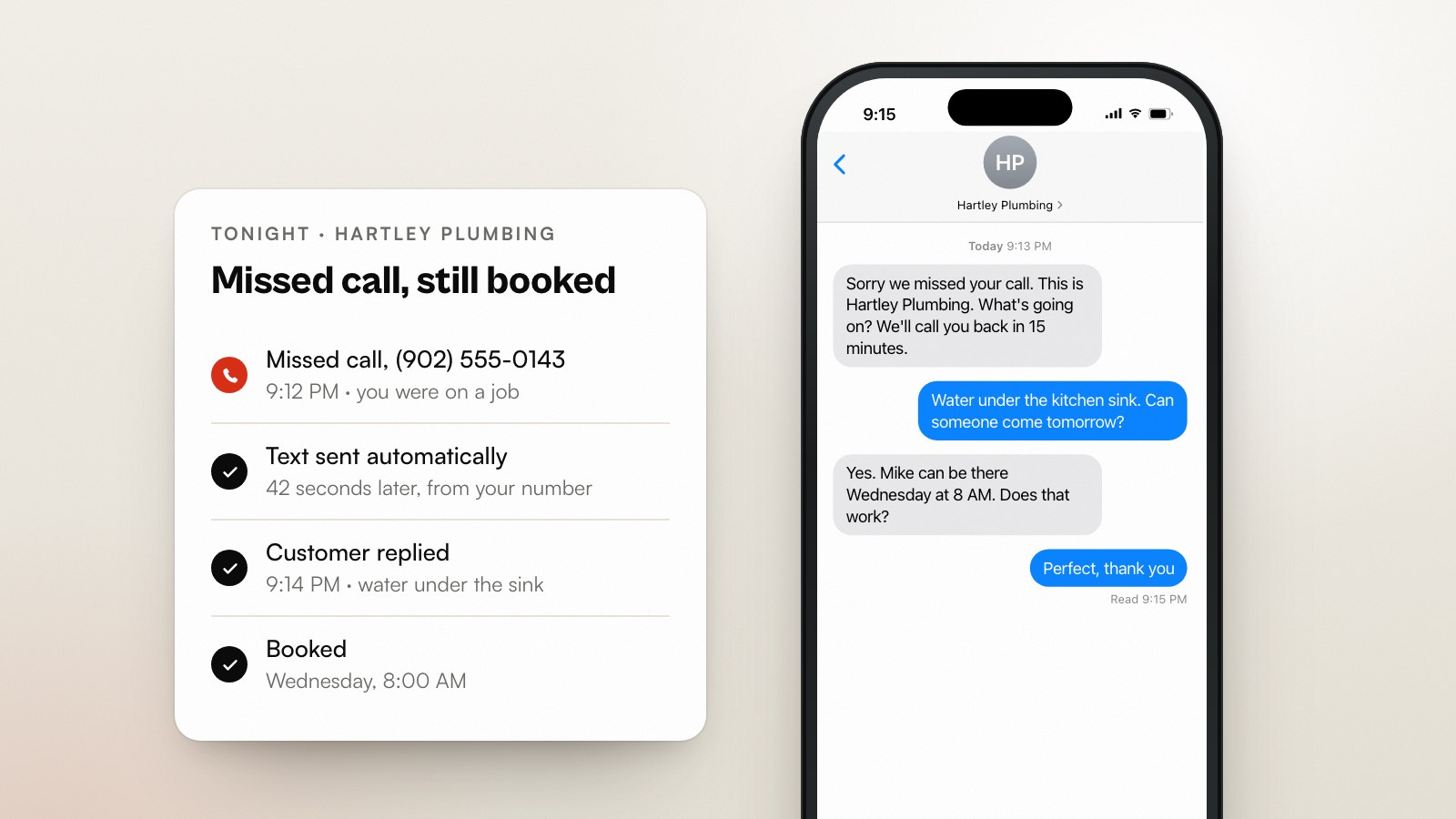
When a call goes unanswered, the system sends a text within seconds: “Sorry we missed you. This is [business]. What do you need help with, and what's the address?” The customer replies when it suits them, and you pick the thread up with the details already in front of you. It's cheap, fast to set up and it works for non-urgent requests and quote enquiries. We cover how to build one in missed-call text-back for contractors, and compare the ready-made tools in the best missed-call text-back software.
Its limit is urgency. Someone with water coming through the ceiling won't wait for a text thread. So write the message to include an emergency line: “If this is an emergency, call [number] now.” The number can ring your on-call phone or an answering service.
Option 5: An AI voice agent
An AI voice agent answers the call, talks to the customer, collects the details and can book a visit. It can sound natural, and it's available at any hour. It also makes mistakes: mishearing addresses, struggling with accents and background noise, or promising something you don't offer.
If you try one, start narrow. Let it take messages and book non-urgent visits only, send every call summary to you in text, and route anything that sounds urgent to a person. Tell callers they're talking to an automated assistant. Test it with twenty real calls from friends, in different accents and from noisy places, before it goes live. Our own product, Ringhero, is built this way: it says it is an AI on every call, sends emergencies straight to whoever is on call, and texts you the job.
How to pick: a simple decision table
| Your situation | Start with | Add |
|---|---|---|
| Emergency trade (plumbing, heating, electrical), small team | Answering service or on-call phone | Text-back for non-urgent enquiries |
| Scheduled work (renovation, landscaping, painting) | Missed-call text-back | A clear voicemail greeting |
| One-person shop, no one to rotate | Text-back with an emergency line to an answering service | Set honest after-hours opening times |
| Team of five or more with steady call volume | On-call rotation plus text-back | Trial an AI voice agent for overflow |
Work out what you're losing: a 10-minute check
- Open your phone's call log for the last 30 days and count the missed calls outside working hours.
- Mark how many were new numbers, not existing customers or suppliers.
- Estimate what share would have been a real job. Be conservative, and use your own close rate from past quotes.
- Multiply by your average job value. That's the rough value of the problem.
- Compare that number with the monthly cost of the option you're considering.
If the number is small, a better voicemail greeting is probably enough. If it's large, fixing it is likely worth a few hours of setup. Either way, you're deciding from your own call log, not from someone else's benchmark. Our missed-call revenue calculator does the arithmetic for you.
Rules to follow in Canada
A customer who calls you and gets a text reply about that enquiry is generally in a different position from someone you cold-text. Still, Canada has rules on commercial electronic messages. Under CASL, messages need identification of the sender and a way to opt out, and consent matters. Keep automatic texts short, name your business, honour STOP at once and don't use them to send promotions. This isn't legal advice. If you text at volume, check your setup with a lawyer.
Setup checklist
- Write down what counts as an emergency for your trade, in one sentence.
- Set your business hours on your Google Business Profile so customers know what to expect.
- Record a clear voicemail greeting with a callback time.
- Set up an automatic text for missed calls, with an emergency number inside it.
- Decide who sees after-hours messages first thing in the morning, and by what time they must reply.
- Review the log every month and adjust.
The common thread is a fast first response and a person who owns the next step. The tool matters less than that. If you are deciding what else to automate, our guide to where AI automation actually pays off has a simple scoring filter.
After-hours calls FAQ
Do I need to answer calls at night?
Only if your trade has real emergencies. For scheduled work, a fast text reply and a callback first thing in the morning is usually enough.
Is an answering service worth it for a small contractor?
It can be, if emergencies are a real part of your work. Check your own missed-call log first, then ask for a trial.
Can I use a missed-call text-back instead of an answering service?
For non-urgent enquiries, yes. For emergencies, include an emergency number in the text so the caller can reach a person.
Will customers mind talking to an AI?
Some will. Tell them it's an automated assistant, keep it to simple tasks and make it easy to reach a person.
What should the after-hours message say?
Your business name, that you saw the call, one question about what they need and an emergency number. Keep it under three sentences.
Want the text-back and the follow-up running without building it yourself? Our team sets up AI automation for trades businesses at fixed prices. You can see the pricing first.